
How to Renew Your Medical Cannabis Card: When to Renew, What Changes, and How to Avoid a Lapse
by Nida Hammad · May 22, 2026
Complete guide on how to renew your medical cannabis card. Covers renewal timelines, state requirements, lapse consequences, and how to renew via LeafyDoc.

- Medical cannabis cards must be renewed every one to three years depending on the state, and most states require a physician re-evaluation before the state renewal can be submitted.
- LeafyDoc recommends starting the renewal process 30 to 45 days before your card expires to allow time for the physician evaluation, state processing, and postal delivery without any gap in dispensary access.
- A lapsed medical cannabis card means immediate loss of legal purchase rights at licensed dispensaries, and in states without recreational access, an expired card can create legal exposure for possession.
- The renewal physician evaluation is typically shorter and more streamlined than the initial certification, often completed in under 15 minutes, and can be done entirely online through LeafyDoc from any device.
- Renewal perks for existing cardholders can include dispensary anniversary discounts, no sales tax in states like California, Delaware, Florida, Massachusetts, and New Hampshire, and in many states priority access and higher possession limits compared to recreational buyers.
Understanding how to renew your medical cannabis card is just as important as getting it the first time. For patients who depend on medical cannabis to manage a chronic condition, a lapse in card validity means a complete and immediate loss of legal access to licensed dispensaries. Knowing exactly when your card expires, what the renewal process involves, and how it differs from your original application gives you the control to stay protected without any gap in your treatment. This guide covers everything you need to know about how to renew your medical cannabis card across every active state program, including when to start, what the physician evaluation covers, what changes between your first and subsequent renewals, and the legal consequences of letting your card expire.
Why Renewing Your Medical Cannabis Card Is Not Optional
A medical cannabis card is not a one-time document. It is a time-limited certification that requires periodic renewal to remain valid. The moment your card expires, your legal status as a registered medical cannabis patient ends. Licensed dispensaries are legally prohibited from accepting expired patient credentials, and state online registries automatically flag expired patients as no longer certified. For patients managing serious chronic conditions who use cannabis consistently as part of their treatment plan, this is not an inconvenience. It is a complete disruption of their medical access.
According to NORML’s state medical marijuana law database, medical cannabis is now legal in the majority of U.S. states, but each state program operates under its own specific rules governing patient registration, card validity periods, and renewal requirements. The April 2026 federal rescheduling of state-licensed medical marijuana to Schedule III, as reported by NORML’s federal rescheduling coverage, validates the legitimacy of state programs but does not change state-level card renewal requirements. Patients in every state must still comply with their state program’s validity period and renewal process.
The National Conference of State Legislatures state medical cannabis laws tracker documents the legislative framework governing these programs and confirms that renewal requirements are set at the state level with no federal override. This means the responsibility for tracking your card’s expiration date and initiating renewal before that date passes falls entirely on you as the patient.
How to Renew Your Medical Cannabis Card: The Two-Part Process
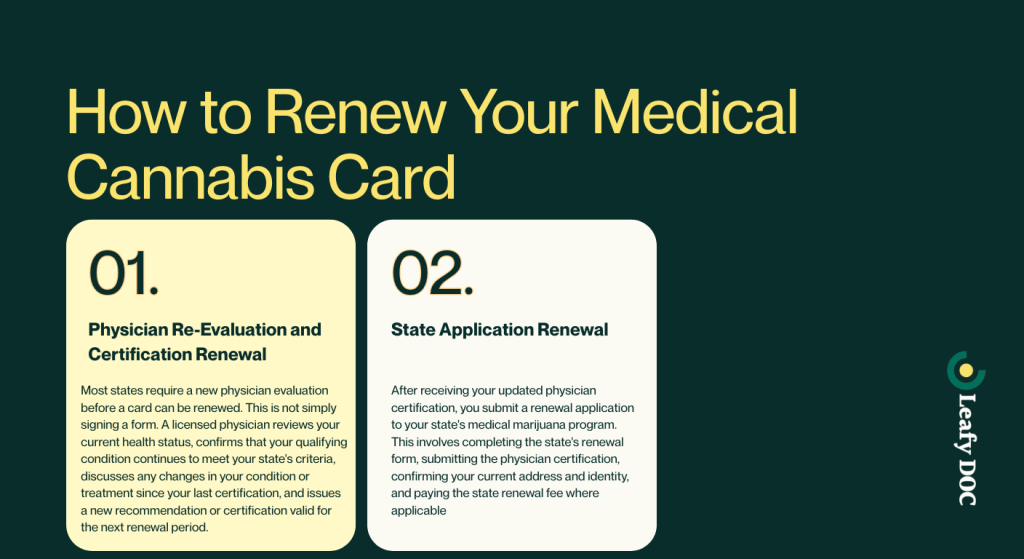
In most states, how to renew your medical cannabis card involves two distinct steps that must be completed in sequence. Understanding both steps before you begin prevents delays and ensures your renewal is completed before your current card expires.
Part 1: Physician Re-Evaluation and Certification Renewal
Most states require a new physician evaluation before a card can be renewed. This is not simply signing a form. A licensed physician reviews your current health status, confirms that your qualifying condition continues to meet your state’s criteria, discusses any changes in your condition or treatment since your last certification, and issues a new recommendation or certification valid for the next renewal period. This step must be completed before the state application can be submitted, because the state program requires a current physician certification as part of the renewal documentation.
The renewal physician evaluation is significantly shorter and more focused than the initial certification. Because your medical history is already documented from your original evaluation, the physician can move more quickly through the assessment. With LeafyDoc, renewal consultations typically take under 15 minutes and are available by phone or video the same day you book. Both new and returning LeafyDoc patients can renew. If you originally got your card through a different provider, LeafyDoc can still conduct your renewal evaluation.
Part 2: State Application Renewal
After receiving your updated physician certification, you submit a renewal application to your state’s medical marijuana program. This involves completing the state’s renewal form, submitting the physician certification, confirming your current address and identity, and paying the state renewal fee where applicable. According to LeafyDoc’s renewal information, some states require patients to register with the state after receiving their certification from the doctor, while others do not require formal state registration at all. Virginia, for example, eliminated the requirement to register with the Board of Pharmacy as of July 2022, meaning the physician certification alone is sufficient.
State processing timelines for renewals mirror initial application processing times, ranging from same-day digital confirmation in faster states to up to 30 days in states that mail physical cards. Beginning the physician evaluation step well before your current card expires gives the state renewal application enough time to be processed before any gap in your patient status occurs.
The Renewal Window: When Is the Right Time to Start
LeafyDoc strongly recommends beginning the renewal process 30 to 45 days before your card’s expiration date. This recommendation reflects the combined timeline of scheduling and completing the physician evaluation, the state application submission and processing period, and in physical card states, the postal delivery timeline. Starting 30 to 45 days before expiration provides a reasonable buffer for each of these stages without any gap in legal access.
Some patients wait until their card has already expired to begin the renewal process. While renewal after expiration is technically possible in many states, it creates a period during which the patient has no valid card and cannot legally purchase from a licensed dispensary. For patients who depend on medical cannabis for daily symptom management, particularly those managing chronic pain, severe anxiety, PTSD, or other ongoing conditions, this gap represents a real and significant disruption to their treatment.
The practical advice from LeafyDoc is to set a reminder in your calendar at both the 45-day and 30-day marks before your expiration date. Many dispensaries also track patient card expiration dates and will notify regular customers approaching expiration. Accepting these notifications and acting on the 45-day reminder rather than the 30-day reminder provides the most comfortable buffer for a smooth, uninterrupted renewal.
State-by-State Medical Cannabis Card Renewal Requirements 2026
The table below covers renewal periods, physician and state requirements, and legal status for all states served by LeafyDoc. Data is sourced from LeafyDoc’s state renewal requirements guide and verified against state program information. Always confirm current requirements directly with your state’s medical marijuana program office before submitting a renewal application, as requirements are subject to legislative changes.
Important Notes: Florida: Physician certification required every 210 days AND state card renewed annually. Telehealth NOT permitted for FL MMJ. | Illinois: Physician renewal only required every 3 years regardless of state registration period. | New York: As of March 2026, physician certification now valid for 2 years (previously 1 year). | Virginia: State registration eliminated July 2022. Physician certification only.
| State | Renewal Period | Renewal Requirements | Legal Status | Official Gov Source |
|---|---|---|---|---|
| Alabama | Annually | Physician certification renewed annually. State registration required annually. | Medical Only | Alabama Medical Cannabis Commission: alamedicalcannabis.gov |
| Alaska | Annually | Physician certification and state registration both renewed annually through Bureau of Vital Statistics. | Recreational + Medical | Alaska Dept of Health: health.alaska.gov/en/services/medical-marijuana-registry-card/ |
| Arizona | Annually (2-yr card) | Physician certification renewed annually. State card valid 2 years. | Recreational + Medical | Arizona ADHS: azdhs.gov/licensing/medical-marijuana/index.php |
| Arkansas | Annually | Physician certification and state registration renewed annually. Processing up to 14 business days. | Medical Only | Arkansas Dept of Health MMJ: mmj.adh.arkansas.gov/ |
| California | Annually (optional) | Physician certification renewed annually. State MMIC card is optional. County health dept required. | Recreational + Medical | California CDPH: cdph.ca.gov/Programs/CHSI/Pages/MMICP-FAQs.aspx |
| Colorado | Annually | Physician certification and state registration renewed annually through Colorado MED. | Recreational + Medical | Colorado MED: sbg.colorado.gov/med-patients |
| Connecticut | Annually | Physician certification and state card renewed annually through CT DCP portal. | Recreational + Medical | Connecticut DCP: portal.ct.gov/DCP/Medical-Marijuana-Program/Medical-Marijuana-Program |
| Delaware | Annually | Physician certification and state registration renewed annually. Online faster than paper. | Recreational + Medical | Delaware Marijuana Commissioner: marijuana.delaware.gov/ |
| Florida | Annually (card) / Every 210 days (physician) | Physician certification every 210 days. State card annually at $75. Telehealth NOT permitted. Renewal window opens 45 days before expiration. | Medical Only | Florida OMMU: knowthefactsmmj.com/patients/cards/ |
| Georgia | Every 5 Years | Low-THC Oil Registry card valid for 5 years. Renewal through Georgia AMCC. | Medical Only (Low-THC) | Georgia AMCC: gmcc.georgia.gov/ |
| Hawaii | Annually | Physician certification and state registration renewed annually. Processing approx 30 days. | Medical Only | Hawaii Dept of Health: health.hawaii.gov/medicalcannabisregistry/ |
| Illinois | 1-3 Yrs (state) / Every 3 Yrs (physician) | State registration 1, 2, or 3 years. Physician certification NOT required until 3 years have passed regardless of state registration choice. | Recreational + Medical | Illinois Dept of Public Health: dph.illinois.gov/topics-services/prevention-wellness/medical-cannabis.html |
| Iowa | Annually | Physician certification and state registration renewed annually. Very limited low-THC program. | Medical Only (Low-THC) | Iowa Dept of Public Health: idph.iowa.gov/medical-cannabidiol |
| Kentucky | Annually | Program launched January 2025. Annual renewal expected. | Medical Only | Kentucky Cannabis: cannabis.ky.gov/Pages/Patients.aspx |
| Louisiana | Annually | Physician prescription renewed annually through licensed pharmacies. No separate state patient card. | Medical Only | Louisiana Board of Pharmacy: pharmacy.la.gov/medical-marijuana |
| Maine | Annually | Physician certification and state registration renewed annually. | Recreational + Medical | Maine Office of Cannabis Policy: maine.gov/dafs/ocp/medical-use |
| Maryland | Every 3 Years | Patient card renewed every 3 years. Caregivers every 2 years. Physician renewal required before state renewal. | Recreational + Medical | Maryland Medical Cannabis Commission: mmcc.maryland.gov/ |
| Massachusetts | Annually | Physician certification and state registration renewed annually. | Recreational + Medical | Massachusetts Cannabis Control Commission: mass-cannabis-control.com/ |
| Michigan | Every 2 Years | Physician certification and state registration renewed every 2 years. | Recreational + Medical | Michigan CRA: michigan.gov/cra/sections/mmp |
| Minnesota | Annually | Physician certification and state registration renewed annually. | Recreational + Medical | Minnesota Dept of Health: health.state.mn.us/people/cannabis/index.html |
| Mississippi | Annually | Physician certification and state registration renewed annually. | Medical Only | Mississippi State Dept of Health: msdh.ms.gov/msdhsite/index.cfm/44,0,388,html |
| Missouri | Annually | Physician certification and state registration renewed annually. | Recreational + Medical | Missouri DHSS: health.mo.gov/safety/medical-marijuana/ |
| Montana | Annually | Physician certification and state registration renewed annually. | Recreational + Medical | Montana Dept of Revenue: mtrevenue.gov/cannabis/ |
| Nebraska | Annually | Program launched early 2026. Annual renewal expected once fully operational. | Medical Only (New) | Nebraska Medical Cannabis Commission: medicalcannabis.nebraska.gov/ |
| Nevada | Annually (2-yr card) | Physician certification renewed annually. State card valid 2 years. | Recreational + Medical | Nevada Cannabis Compliance Board: ccb.nv.gov/patients/ |
| New Hampshire | Annually | Physician certification and state registration renewed annually. | Medical Only | NH Therapeutic Cannabis: dhhs.nh.gov/programs-services/therapeutic-cannabis |
| New Jersey | Annually (physician) / Every 2 Yrs (state) | Physician renewal annually. State card renewed every 2 years. | Recreational + Medical | NJ Cannabis Regulatory Commission: nj.gov/cannabis/patients/ |
| New Mexico | Every 3 Years | Physician certification and state card valid up to 3 years before renewal required. | Recreational + Medical | NM Dept of Health: nmhealth.org/about/mcp/srvs/ |
| New York | Every 2 Years (as of March 2026) | Physician certification now valid for 2 years (expanded March 2026). No separate state card required. Certification serves as registry ID. | Recreational + Medical | NY State Dept of Health: health.ny.gov/regulations/medical_marijuana/patients/ |
| North Dakota | Every 2 Years | Physician certification and state registration renewed every 2 years. | Medical Only | ND Dept of Health and Human Services: hhs.nd.gov/medical-marijuana |
| Ohio | Annually | Physician certification and state registration renewed annually. | Recreational + Medical | Ohio Medical Marijuana Control Program: medicalmarijuana.ohio.gov/ |
| Oklahoma | Every 2 Years | Physician certification and state card renewed every 2 years. | Medical Only | Oklahoma Medical Marijuana Authority: omma.ok.gov/patients |
| Oregon | Annually | Physician certification and state registration renewed annually. | Recreational + Medical | Oregon Health Authority OMMP: oregon.gov/oha/ph/preventionwellness/marijuana/pages/ommp.aspx |
| Pennsylvania | Annually | Physician certification and state registration renewed annually. $50 state fee. Program notifies patients 60 days before expiration. | Medical Only | Pennsylvania Dept of Health: pa.gov/agencies/health/programs/medical-marijuana |
| Rhode Island | Annually | Physician certification and state registration renewed annually. | Recreational + Medical | Rhode Island Dept of Business Regulation: dbr.ri.gov/medicinal-marijuana |
| South Dakota | Annually | Physician certification and state registration renewed annually. | Medical Only | South Dakota Dept of Health: doh.sd.gov/information/medical-marijuana/ |
| Texas | Annually | Physician certification renewed annually and entered directly into CURT registry. No physical card issued. Telehealth permitted. | Medical Only (CUP) | Texas DPS Compassionate Use: dps.texas.gov/section/regulatory/compassionate-use-program |
| Utah | Annually | Physician certification and state registration renewed annually. | Medical Only | Utah Medical Cannabis: medicalcannabis.utah.gov/ |
| Vermont | Annually | Physician certification and state registration renewed annually. | Recreational + Medical | Vermont Cannabis Control Board: ccb.vermont.gov/patients |
| Virginia | Annually | Physician certification renewed annually. State Board of Pharmacy registration eliminated July 2022. | Recreational + Medical | Virginia Cannabis Control Authority: cca.virginia.gov/patients |
| Washington State | Annually | Physician authorization renewed annually. State card issued at retail dispensary for $1. | Recreational + Medical | WA State Liquor and Cannabis Board: lcb.wa.gov/marijuana/medical-marijuana |
| Washington D.C. | Every 2 Years | Physician certification and state card renewed every 2 years. | Recreational (no retail) + Medical | DC Health Medical Cannabis: dchealth.dc.gov/service/medical-cannabis-program |
| West Virginia | Annually | Physician certification and state registration renewed annually. | Medical Only | WV Medical Cannabis Program: dhhr.wv.gov/bph/Documents/Medical%20Cannabis%20Program/Medical-Cannabis-Office.aspx |
Data Sources: All data sourced from official state government health departments, cannabis control agencies, and medical marijuana program offices as listed in the Gov Source column. Data verified April 2026. Always confirm current requirements directly with your state program before renewing.
Ready to start your medical cannabis card renewal? Book your renewal evaluation with LeafyDoc today. Same-day appointments available seven days a week. 10 to 15 minute online evaluation by phone or video. New and returning patients welcome. 100% money-back guarantee.
What Changes During a Renewal vs Your First-Time Application
Patients sometimes assume that renewal is simply a repeat of the original application process. In practice, there are several meaningful differences that make renewal faster and more straightforward than the initial certification.
The Physician Evaluation Is Shorter
Your first certification required the physician to establish your medical history from scratch, confirm your qualifying condition, and assess whether medical cannabis was appropriate for your situation. At renewal, your history is already on record. The physician confirms that your qualifying condition continues to meet your state’s criteria, reviews any changes in your health status or treatment plan since the last certification, and issues an updated recommendation. This makes renewal evaluations consistently shorter than initial evaluations.
Your Condition May Have Changed
The renewal evaluation is also an opportunity to discuss changes in your condition since your last certification. If your symptoms have worsened, if you have developed additional qualifying conditions, or if your treatment needs have evolved, the renewal appointment is the appropriate time to address these changes with the physician. The updated physician notes from your renewal will reflect your current health status, which may be relevant if your state’s program allows for additional product access or possession amounts based on specific condition severity.
Documentation Requirements Are Typically Less Extensive
First-time applications often require more detailed supporting documentation, including in some states proof of diagnosis from a treating specialist. Renewal applications typically require only the updated physician certification and the state renewal form. The patient is already in the state registry, their identity has been verified, and their qualifying condition has been previously accepted by the program. This significantly reduces the administrative burden of renewal compared to the original application.
Illinois: A Notable Exception
Illinois is worth highlighting because it operates differently from most states. Illinois patients register with the state for one, two, or three years. Regardless of how long they choose to register with the state, they do not need to renew their physician certification until three years have passed. This means an Illinois patient who registered for one year needs to renew their state registration annually but only sees the physician every three years. This structure separates the state administrative renewal from the physician evaluation renewal in a way that most other states do not.
What Happens If Your Medical Cannabis Card Lapses
Understanding the consequences of a lapsed card is the strongest motivation for renewing early. An expired medical cannabis card has real legal and practical consequences that affect both your access to medication and your legal standing in your state.
You cannot purchase from licensed dispensaries. Once your card expires, licensed dispensaries are legally prohibited from accepting it. State online registries update patient status in real time, and dispensary point-of-sale systems check patient registry status before completing a transaction. An expired card will be declined at the point of purchase, with no exceptions.
You lose legal protection for possession. In states that do not have recreational cannabis access, an expired medical card eliminates your legal protection for possession and use. According to NORML’s state laws overview, even a barely expired card can result in legal liability in states where recreational use is prohibited, because the legal protection afforded to medical patients applies only to currently registered, certified patients. LeafyDoc explicitly notes that you can still be held liable if your state does not allow recreational use even if your medical card has only recently expired.
You may lose dispensary loyalty status and benefits. Many dispensaries maintain patient loyalty programs tied to active medical card status. Anniversary discounts, priority queue access, and medical-only product access are tied to your active certification. A lapsed card removes these benefits until renewal is complete.
Re-registration may take time. If your card lapses and you must restart the process, you may face the same processing timelines as a new patient in some states, rather than the faster renewal pathway. Starting the renewal before your card expires ensures you stay on the renewal track rather than being treated as a new applicant.
How Your Condition or Treatment May Have Changed Since Your Last Card
The renewal appointment is not just a bureaucratic hurdle. It is a clinical check-in with a licensed physician who can reassess your condition and update your treatment approach based on how your health has evolved since your last certification. Patients who have been using medical cannabis consistently over the past year or more often have meaningful updates to discuss.
Common changes worth discussing at renewal include shifts in symptom severity, changes in other medications you are taking, new secondary diagnoses that may be separately qualifying under your state’s program, changes in the delivery methods or product types you find most effective, and any concerns about tolerance or dosing that have emerged over time. The renewal physician at LeafyDoc can address all of these topics and update your certification to reflect your current clinical picture.
According to LeafyDoc’s qualifying conditions guide, qualifying conditions vary by state, and a patient whose primary condition was chronic pain may have developed an additional qualifying condition such as PTSD, anxiety, or a neurological disorder that is worth documenting in the renewal evaluation. Comprehensive renewal documentation strengthens your ongoing patient record and ensures your certification accurately reflects your full health picture.
Renewal Perks: What Returning Patients Keep and Gain
Renewing your medical cannabis card on time does more than just maintain your legal access. It preserves a set of patient-specific benefits that recreational buyers in the same state do not have access to.
LeafyDoc notes that dispensaries in certain states offer anniversary discounts to patients on their renewal date. This is a direct financial benefit that rewards patients who maintain continuous, uninterrupted registration. In some states this discount can be applied to a full purchase on the renewal anniversary date, representing meaningful savings for regular cannabis consumers.
Tax exemptions remain one of the most financially significant patient-only benefits. LeafyDoc confirms that medical marijuana patients are exempt from sales tax in certain states including California, Delaware, Florida, Massachusetts, and New Hampshire. A patient who purchases regularly in these states saves the full applicable sales tax percentage on every dispensary visit, an advantage that compounds significantly over the course of a year.
Medical patients in most states also benefit from expanded menu access at licensed dispensaries. Medical-only products, including higher-potency formulations and specialized delivery formats not available to recreational buyers, remain accessible to patients with active cards. Priority access during periods of product shortage or high dispensary traffic is another patient-specific benefit that lapsed cardholders lose immediately upon expiration.
According to NORML’s state medical cannabis law database, state protections for medical cannabis patients extend to areas including employment in some states, housing access, and in certain jurisdictions firearm-related provisions. These legal protections apply only to patients with currently active, valid medical certifications. Maintaining an active card preserves all of these protections continuously.
How to Renew Your Medical Cannabis Card Online With LeafyDoc
LeafyDoc makes how to renew your medical cannabis card as simple and fast as the original application. The renewal process is fully online, HIPAA-compliant, and available to both returning LeafyDoc patients and patients who originally obtained their cards through a different provider.
Returning LeafyDoc patients log in through the returning patient portal to access their existing records and schedule a renewal evaluation. New patients renewing with LeafyDoc for the first time complete a brief intake form with their personal details and current card information before scheduling.
The renewal evaluation itself follows the same telehealth format as the initial consultation. A licensed, board-certified physician connects with you by phone or video at your scheduled time. The evaluation typically takes 10 to 15 minutes and covers your current health status, any changes since your last certification, and confirmation that your qualifying condition continues to meet your state’s criteria. If you qualify, your updated physician certification is delivered to your email immediately after the visit.
LeafyDoc is available for renewal appointments seven days a week with same-day and next-day availability. The platform is accessible from any smartphone, tablet, or computer, and no special software or app download is required in most cases. All medical information is protected with bank-level encryption and the platform is fully HIPAA-compliant. LeafyDoc also accepts renewals from patients who originally got their card through any other provider, so switching to LeafyDoc for a renewal does not require any additional documentation beyond what is needed for a standard renewal evaluation.
According to the National Conference of State Legislatures state cannabis legislation database, state cannabis programs continue to evolve through annual legislative sessions, and renewal requirements are updated accordingly. LeafyDoc stays current with these changes and guides patients through any state-specific updates that affect their renewal process at the time of their appointment.
Do not wait for your medical cannabis card to expire. Renew online with LeafyDoc today. 10 to 15 minute telehealth evaluation. Same-day availability. New and returning patients welcome. 100% money-back guarantee. Protect your legal access and your patient benefits before they lapse.
Frequently Asked Questions
How long before expiration should I renew my medical cannabis card?
LeafyDoc recommends starting the renewal process 30 to 45 days before your card expires. This timeline accounts for scheduling and completing the physician evaluation, submitting the state renewal application, and allowing for state processing and postal delivery of the physical card where applicable. Starting 45 days before expiration provides the most comfortable buffer. Waiting until the last week before expiration risks a gap in your legal patient status if any step in the process takes longer than expected.
Do I need to see a doctor every time I renew my medical cannabis card?
In most states, yes. The majority of active state medical marijuana programs require a physician re-evaluation as part of the renewal process. The physician confirms that your qualifying condition still meets your state’s criteria and issues an updated certification before the state application can be submitted. Illinois is a notable exception, where patients renew with the state annually or every two to three years depending on their registration choice, but only need to see the physician every three years. Check your state’s specific requirements using the table in this article or by visiting your state’s official medical marijuana program website.
Can I renew my medical cannabis card if I originally got it through a different provider?
Yes. LeafyDoc accepts renewal evaluations from patients who originally obtained their cards through any other provider. New LeafyDoc patients renewing for the first time complete a brief intake form with their personal and card information before scheduling. There is no requirement to return to the same physician or platform that issued your original certification. The renewal evaluation covers your current health status and qualifying condition regardless of who conducted your initial assessment.
What happens if my medical cannabis card expires before I renew?
Once your card expires, you immediately lose legal access to licensed dispensaries, which are prohibited from accepting expired patient credentials. In states without recreational cannabis access, an expired card also removes your legal protection for possession and use, creating potential legal exposure even for small amounts. Dispensary loyalty benefits, tax exemptions, and priority access also end with card expiration. If your card lapses, you should initiate the renewal process immediately through a telehealth provider like LeafyDoc to minimize the gap in your legal patient status.
How is the renewal evaluation different from my original medical cannabis evaluation?
The renewal evaluation is typically shorter and more streamlined than the original. Because your medical history is already documented from your first certification, the physician can focus on confirming that your qualifying condition continues to meet your state’s criteria and discussing any changes in your health status since the last evaluation. Renewal evaluations with LeafyDoc typically take 10 to 15 minutes compared to the 15-minute average for initial certifications. Documentation requirements are also generally less extensive at renewal, since the state already has your identity and basic records on file.
Does the cost of renewing my medical cannabis card differ from the initial application?
Renewal fees are generally lower than initial certification fees because the evaluation is more streamlined for returning patients. The renewal cost has two components: the physician evaluation fee paid to LeafyDoc and the state renewal fee paid separately to your state’s program. State renewal fees are typically equal to or lower than initial registration fees, and some states that charge a higher initial application fee apply a reduced rate for renewals. LeafyDoc’s money-back guarantee applies to renewal evaluations, so you are only charged if the physician confirms you continue to qualify.
Last Updated: May 25, 2026
Get Approved for Your Medical Marijuana Card in Minutes!

Get Your Medical Card
Connect with a licensed physician online in minutes
- National Conference of State Legislatures. (2026). State medical cannabis laws. https://www.ncsl.org/health/state-medical-cannabis-laws
- National Conference of State Legislatures. (2026). State cannabis policy enactment database. https://www.ncsl.org/health/state-cannabis-legislation-database
- National Conference of State Legislatures. (n.d.). Cannabis and employment: Medical and recreational policies in the states. https://www.ncsl.org/health/cannabis-and-employment-medical-and-recreational-policies-in-the-states
- NORML. (2026). Medical marijuana laws by state. https://norml.org/laws/medical-laws/
- NORML. (n.d.). State laws: Cannabis laws and penalties. https://norml.org/laws/
- NORML. (2026, April 23). Justice Department moves to federally reschedule state-approved medical cannabis products. https://norml.org/blog/2026/04/23/justice-department-moves-to-federally-reschedule-state-approved-medical-cannabis-products/
- NORML. (2026, February 27). California medical marijuana law. https://norml.org/laws/medical-laws/california-medical-marijuana-law/NORML. (2025, August 19). Cannabis rescheduling: Myths versus reality. https://norml.org/blog/2025/08/19/cannabis-rescheduling-myths-versus-reality/
-
Supports the physician re-evaluation and telehealth renewal section: U.S. Department of Health and Human Services. (n.d.). What should I know before my telehealth visit? https://telehealth.hhs.gov/patients/what-should-i-know-before-my-telehealth-visit
-
Supports the legal consequences of a lapsed card and state patient protections section: Americans for Safe Access. (n.d.). Patient rights and medical cannabis laws. https://www.safeaccessnow.org/patients
-
Supports the Illinois renewal exception and multi-year card validity section: Illinois Department of Public Health. (2026). Medical cannabis patient program. https://dph.illinois.gov/topics-services/prevention-wellness/medical-cannabis.html
-
Supports the tax exemption and dispensary benefits section for returning patients: California Department of Public Health. (2026). Medical cannabis safety branch. https://www.cdph.ca.gov/Programs/CHSI/Pages/Medical-Cannabis-Safety-Branch.aspx
-
Supports the federal rescheduling context and state program legitimacy section: National Organization for the Reform of Marijuana Laws. (2025, December 16). Cannabis rescheduling: Separating fact from fiction. https://norml.org/blog/2025/12/16/cannabis-rescheduling-separating-fact-from-fiction
-
Florida (Official OMMU source) https://knowthefactsmmj.com/patients/cards/
- Arkansas (Official state MMJ registry) https://mmj.adh.arkansas.gov/
- California (Official CDPH) https://www.cdph.ca.gov/Programs/CHSI/Pages/MMICP-FAQs.aspx
- Michigan (Official CRA) https://www.michigan.gov/cra/faq/program-list/applicant-questions/how-long-does-it-take-to-receive-a-registry-identification-card
- New York (Official NYS Dept of Health) https://www.health.ny.gov/regulations/medical_marijuana/patients/
- Pennsylvania (Official PA Dept of Health) https://www.pa.gov/agencies/health/programs/medical-marijuana
- LeafyDoc Renewal Page (covers California, Connecticut, Illinois, Iowa, Louisiana, Maine, Maryland, Massachusetts, Michigan, Minnesota, Missouri, Montana, New Jersey, New York, Ohio, Oklahoma, Pennsylvania, Texas, Virginia, Washington D.C., West Virginia) https://leafydoc.com/renewal
Like This Article?
Share with your friends
Table of Contents
Keep Reading
-
Navigating The Laws For Obtaining A Medical Marijuana Card
Unlock the benefits of medical marijuana legally with our ultimate guide to navigating the laws for obtaining a medical marijuana card. Don’t miss out on the hassle-free process – get your card now!
-
4 Steps on How to Get Medical Marijuanas Card CA
Learn the essential steps on how to get a medical marijuanas card in CA for your health needs.
-
Is It Okay To Combine Marijuana And Cold Medicine?
Uncover the Truth: Can You Safely Combine Nyquil and Weed? Find out before you make a risky decision. Don’t miss this important information – click now!