
Qualifying medical conditions for medical cannabis in 2026
by Nida Hammad · May 19, 2026
Discover which medical conditions qualify for a medical marijuana card in 2026. Compare state-by-state requirements and learn how to get your MMJ card.

- 40 states and Washington DC now have comprehensive medical cannabis laws as of March 2026, according to the Congressional Research Service.
- Medical conditions for medical cannabis vary by state. Chronic pain, PTSD, cancer, and epilepsy appear on nearly every state list.
- Texas majorly expanded its program in September 2025 under HB 46, adding chronic pain, Crohn’s disease, traumatic brain injury, and terminal illness to its qualifying conditions.
- Cannabis remains a Schedule I controlled substance under federal law, though reclassification to Schedule III is currently under review by the DEA.
- LeafyDoc connects patients with licensed physicians for fast, confidential medical cannabis evaluations.
As of March 2026, 40 states and Washington DC have comprehensive laws allowing the use of medical cannabis. But knowing your state has a program is only the first step. What actually determines your eligibility is whether your specific condition appears on your state’s approved list of medical conditions for medical cannabis. And that list is different in every state.
What qualifies you in California may not qualify you in Florida. A condition that is on the approved list in New York might not appear in Georgia. This creates real confusion for patients who need clear answers about whether they can legally access cannabis for their health conditions.
This guide gives you those answers. We cover what qualifying conditions are, how states decide which conditions to include, the most commonly accepted conditions across all states, and a breakdown of how different types of states approach their qualifying lists. We also walk you through exactly how to apply.
If you want to know right now whether your condition qualifies in your state, LeafyDoc.com connects you with licensed physicians who can evaluate your situation and guide you through the approval process.
Medical Conditions for Medical Cannabis: What Are Qualifying Conditions?
Qualifying conditions for medical cannabis are specific health diagnoses or symptoms that a state has officially approved for treatment with medical marijuana. These conditions are written into state law. A licensed physician must confirm that you have one of these conditions before you can receive a medical cannabis recommendation.
For a medical cannabis program, your condition must be on the approved list, and a physician must verify it. According to the Congressional Research Service report on state cannabis programs, each state operates its own independent review process with no federal framework governing which conditions qualify.
How States Decide Which Conditions to Include
States use a combination of medical board review, legislative process, and petition submissions from patients and physicians to approve qualifying conditions. According to the Congressional Research Service report on federal and state cannabis policy, each state operates its own separate review process, which is why qualifying conditions vary so much across state lines. There is no federal framework governing which conditions qualify.
Most states allow petitions for adding new conditions. A patient or physician submits evidence supporting a new condition, and a state review board evaluates it. Review periods typically take six to twelve months. Some states, like Oklahoma, Missouri, and Arkansas, avoid this process entirely by giving physicians broad discretion to certify any condition they deem debilitating.
The Role of Physician Discretion
Your physician plays a central role in the process regardless of which state you are in. Even in states with strict condition lists, the physician reviews your full medical history, not just your diagnosis. They assess whether cannabis is an appropriate treatment given your symptoms, current medications, and treatment history. Documented medical evidence, including diagnosis records, lab results, and specialist reports, strengthens your case.
In states with physician discretion clauses, the physician has even more authority. They can approve patients for conditions not explicitly listed if they determine the condition is debilitating and that cannabis may provide medical benefit. This flexibility is important for patients with rare or emerging conditions.
Most Common Medical Conditions for Medical Cannabis Across States
Medical conditions for medical cannabis vary widely, but a core group of conditions appears on nearly every state list. Understanding these helps you quickly assess whether you are likely to qualify before you even contact a physician.
Chronic Pain
Chronic pain is the most widely accepted qualifying condition across all medical cannabis states. It appears on the qualifying list in the vast majority of states with active programs. Even states with restrictive lists in the past, including Texas, added chronic pain to their qualifying conditions through HB 46 in September 2025. According to the CDC’s Morbidity and Mortality Weekly Report, an estimated 51.6 million US adults, roughly 20.9% of the adult population, experienced chronic pain in 2021. This makes it the most widely represented qualifying condition across medical cannabis programs by patient volume.
Cancer and Chemotherapy Side Effects
Cancer qualifies in nearly every medical cannabis state. This covers not just the cancer diagnosis itself, but the treatment-related symptoms that follow: nausea from chemotherapy, appetite loss, and pain. Some states specifically list cancer-related pain and nausea as qualifying conditions separately from cancer as a diagnosis. The National Cancer Institute’s overview of cannabis in cancer care summarizes the current clinical evidence on cannabinoids for cancer-related symptoms.
PTSD
Post-traumatic stress disorder (PTSD) is now a qualifying condition in the majority of states with medical cannabis programs. Veterans, first responders, and trauma survivors make up a large portion of PTSD patients seeking medical cannabis access. Texas added PTSD through HB 1535 in 2021. Florida includes it under its nine core constitutional conditions. Acceptance continues to grow as clinical evidence on cannabis compounds and trauma response grows.
Epilepsy and Seizure Disorders
Epilepsy and seizure disorders qualify in nearly every state with a medical cannabis program. In fact, many states began their programs exactly to allow cannabis access for pediatric epilepsy patients, especially those with treatment-resistant conditions. The FDA approval of Epidiolex, a CBD-based medication for specific seizure disorders, further legitimized the connection between cannabis-derived compounds and seizure management.
Multiple Sclerosis and Muscle Spasms
Multiple sclerosis (MS) appears on most state qualifying condition lists, typically alongside muscle spasms and spasticity as separate qualifying entries. Patients with MS often use cannabis exactly for spasticity and nerve pain rather than the underlying disease itself. This distinction matters because some states list ‘muscle spasms’ as a standalone qualifying condition that applies beyond MS patients.
HIV/AIDS and Wasting Syndrome
HIV/AIDS and the associated wasting syndrome were among the original qualifying conditions when California launched the first state medical cannabis program in 1996. They remain on most state lists today. Cannabis helps with appetite stimulation, nausea, and pain management in this population.
Mental Health Conditions: Anxiety and Depression
Acceptance of anxiety and depression varies more than most other conditions. Some states include anxiety disorders outright, like Pennsylvania, which includes anxiety as a qualifying condition under its Act 16 program. Others require that anxiety be documented as a symptom of a more primary qualifying condition like PTSD. Depression as a standalone qualifying condition is less common. Patients with anxiety or depression should check their specific state’s list rather than assuming they qualify based on the condition alone.
Common Qualifying Conditions: Acceptance Overview
| Condition | Accepted By | Notes |
| Chronic Pain | Nearly all 40 medical states | Texas added Sept 2025 via HB 46 |
| Cancer | Virtually all 40 medical states | Includes treatment-related symptoms |
| PTSD | Majority of medical states | Expanding rapidly; military veteran focus |
| Epilepsy / Seizures | Nearly all 40 medical states | Often the founding condition in early programs |
| Multiple Sclerosis | Most medical states | Often listed with muscle spasms |
| HIV/AIDS | Most medical states | One of the original qualifying conditions |
| Glaucoma | Many medical states | Accepted where vision loss risk is documented |
| Crohn’s Disease / IBD | Many medical states | Texas added Sept 2025 via HB 46 |
| ALS | Most medical states | Terminal nature strengthens qualification |
| Anxiety Disorders | Select states (PA, FL, others) | Standalone or as PTSD symptom |
| Autism Spectrum Disorder | PA, TX, and select others | Not in all states; growing acceptance |
| Opioid Use Disorder | NY and select others | Harm reduction approach |
State-by-State: How Qualifying Conditions Differ
Medical conditions for medical cannabis look very different depending on which state you are in. States generally fall into one of four categories based on how they approach their qualifying condition lists.
States With Broad Qualifying Lists
California, Colorado, and Oregon lead with the most inclusive qualifying condition lists. California’s program, established by Proposition 215 in 1996, allows physicians to recommend cannabis for any condition where cannabis provides relief. This means physician discretion is essentially unlimited. Colorado similarly allows physicians to approve patients for debilitating medical conditions broadly, including conditions outside the explicit list if the physician determines cannabis is beneficial.
New York includes a wide list covering Alzheimer’s, ALS, autism, cancer, Crohn’s, epilepsy, HIV/AIDS, Huntington’s, IBD, MS, muscular dystrophy, neuropathies, chronic pain, Parkinson’s, PTSD, rheumatoid arthritis, and substance use disorder. Pennsylvania’s list under Act 16 includes 24 conditions including anxiety disorders, autism, opioid use disorder, and chronic pain.
States With Restrictive Lists
Georgia operates a low-THC oil program with a shorter list of qualifying conditions, including cancer, epilepsy, glaucoma, HIV/AIDS, Crohn’s disease, Parkinson’s disease, MS, PTSD, and chronic pain. Access is limited to low-THC oil products only. Louisiana has a more standard program but still keeps a tighter list than broad-discretion states.
Texas in the past had one of the most restrictive programs in the country, limited initially to epilepsy only. Under HB 46, which took effect September 1, 2025, Texas now qualifies patients with epilepsy, seizure disorders, spasticity, MS, ALS, autism, incurable neurodegenerative diseases, PTSD, all cancers, chronic pain lasting more than 90 days, traumatic brain injury, Crohn’s disease, and terminal illnesses. Texas remains a low-THC program capped at 10 mg THC per dose and 1,000 mg per package, and smoking is not permitted.
States With Physician Discretion Clauses
Oklahoma, Missouri, and Arkansas take the broadest approach by allowing physicians to approve patients for any condition they determine is debilitating and may benefit from cannabis. This means patients with conditions not explicitly listed can still qualify if a licensed physician supports the approval. This physician-first model removes much of the paperwork barrier while still requiring professional medical judgment.
States with physician discretion clauses are often more accessible for patients with rare conditions, emerging diagnoses, or conditions that are well-documented in medical literature but not yet included in a state’s explicit list.
How to Get Your Medical Cannabis Card: Step by Step
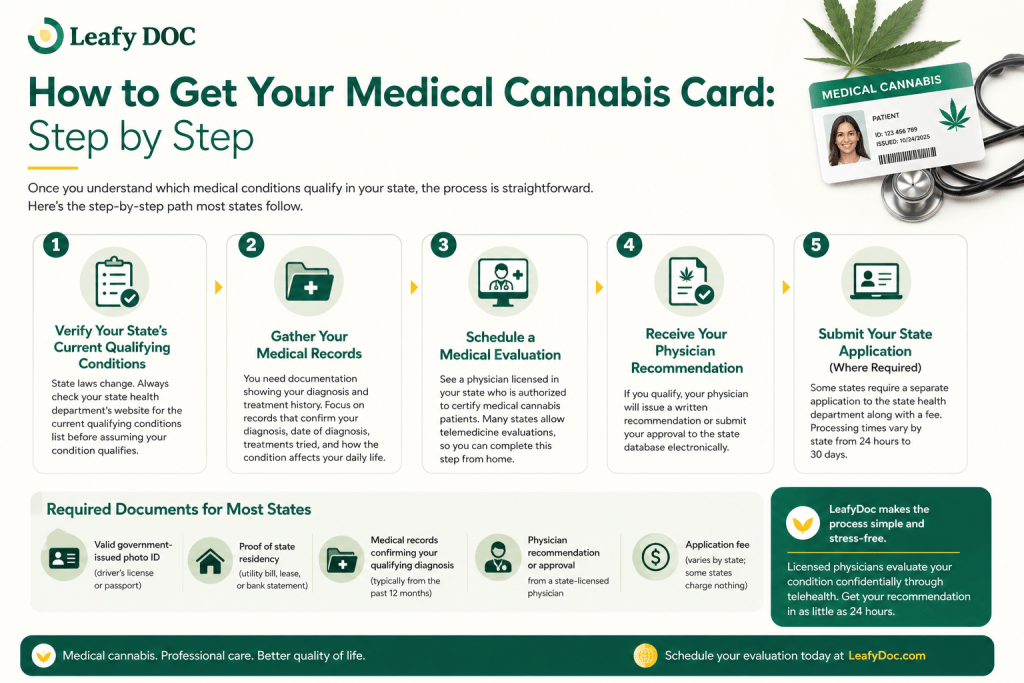
Once you understand which medical conditions for medical cannabis qualify in your state, the apply process is straightforward. Here is the step-by-step path most states follow.
Step 1: Verify Your State’s Current Qualifying Conditions
State laws change. Texas expanded its list in September 2025. Other states update their programs regularly. Always check your state health department’s website for the current qualifying conditions list before assuming your condition qualifies. LeafyDoc’s state eligibility guide is updated regularly and confirms which conditions qualify in each state.
Step 2: Gather Your Medical Records
You need documentation showing your diagnosis and treatment history. This typically includes records from the past 12 months, but some states accept older records if the diagnosis is stable and documented. Gather physician notes, lab results, imaging reports, and any specialist documentation. The stronger your documentation, the smoother the evaluation process.
You do not need to bring your entire medical file. Focus on records that confirm: the name of your qualifying condition, the date of diagnosis, any treatments you have tried, and how the condition affects your daily functioning. The state medical programs operate separately of federal classification, meaning your state medical records are what matter for your card application.
Step 3: Schedule a Medical Evaluation
You need to see a physician licensed in your state who is authorized to certify medical cannabis patients. Many states now allow telemedicine evaluations, which means you can complete the evaluation from home without an office visit. The physician reviews your medical records, evaluates your condition, and determines whether cannabis is an appropriate treatment.
LeafyDoc makes this step straightforward. Licensed physicians in your state evaluate your condition confidentially through a telehealth consultation. Schedule your evaluation at LeafyDoc and get your recommendation in as little as 24 hours.
Step 4: Receive Your Physician Recommendation
If the physician determines you qualify, they complete a written recommendation or, in states with electronic registries, submit your approval directly to the state database. In some states, this recommendation alone allows you to purchase from a licensed dispensary. In others, you submit the recommendation to the state for a formal patient ID card.
Step 5: Submit Your State Application (Where Required)
Some states require a separate application to the state health department. This typically involves submitting your physician recommendation, a valid government-issued ID, proof of state residency, and an application fee. Fees range from $0 (New York) to over $100 in some states. Processing times range from 24 hours to 30 days depending on your state. Program requirements vary widely, which is why checking your state’s current requirements directly before applying is always the right move.
Required Documents for Most States
- Valid government-issued photo ID (driver’s license or passport)
- Proof of state residency (utility bill, lease, or bank statement)
- Medical records confirming your qualifying diagnosis (typically from the past 12 months)
- Physician recommendation or approval from a state-licensed physician
- Application fee (varies by state; some states charge nothing)
Online vs. In-Person Evaluations
Most states now accept telemedicine evaluations for medical cannabis approvals. This is a meaningful change from earlier program years when in-person visits were required. Telehealth evaluations allow you to complete the entire physician consultation from home, which reduces travel time and often shortens the time from application to approval.
Some states still require in-person visits for the initial approval, though renewals may be allowed via telehealth. A small number of states require the approving physician to have an established patient relationship before issuing a recommendation. Check your state’s specific telemedicine rules before scheduling.
LeafyDoc’s telehealth platform serves patients in all qualifying states and uses only licensed physicians authorized to certify medical cannabis patients in each state. The evaluation is confidential and HIPAA-compliant. Getting started takes minutes. Check your eligibility and schedule your evaluation.
Conclusion
The landscape for medical conditions for medical cannabis is broader in 2026 than it has ever been. With 40 states and DC now operating comprehensive medical programs, and states like Texas making major expansions as recently as September 2025, more patients qualify today than at any previous point in US history.
The key variables are your state, your specific condition, and whether you have the medical documentation to support your application. Chronic pain, PTSD, cancer, epilepsy, multiple sclerosis, and HIV/AIDS qualify in the vast majority of states. Less common conditions like autism, opioid use disorder, and anxiety qualify in a growing number of programs. And in states with physician discretion, almost any debilitating condition can qualify if a licensed physician supports the approval.
The fastest way to know whether you qualify is to speak with a licensed physician who understands your state’s requirements. LeafyDoc connects you with those physicians quickly, confidentially, and without an office visit. Schedule your medical cannabis evaluation at LeafyDoc today and find out if your condition qualifies in your state.
Frequently Asked Questions
How many states allow medical cannabis in 2026?
As of March 2026, 40 states and DC have full medical cannabis programs, per the Congressional Research Service. Eight more states allow low-THC or CBD-only access. Five states still ban all cannabis use.
What are the most common medical conditions for medical cannabis?
The most widely accepted medical conditions for medical cannabis across US states are chronic pain, cancer, PTSD, epilepsy and seizure disorders, multiple sclerosis, HIV/AIDS, ALS, Crohn’s disease, and glaucoma. Anxiety disorders, autism, and opioid use disorder are accepted in a growing number of states.
Does chronic pain qualify for a medical cannabis card?
Yes, in the vast majority of states with medical cannabis programs. Chronic pain is the most widely accepted qualifying condition. Even Texas, in the past one of the most restrictive states, added chronic pain to its qualifying list in September 2025 under HB 46. The pain must typically be documented as ongoing and not adequately managed by other treatments.
Does PTSD qualify for a medical cannabis card?
Yes, PTSD is a qualifying condition in the majority of medical cannabis states. It is formally listed in states including Florida, Pennsylvania, New York, Texas (added 2021 via HB 1535), Louisiana, and many others. Veterans and trauma survivors represent a major portion of PTSD patients seeking medical cannabis access.
Can I get a medical cannabis card for anxiety or depression?
It depends on your state. Anxiety disorders are an explicit qualifying condition in Pennsylvania, Florida (under physician discretion), and some other states. Depression as a standalone qualifying condition is less common. In states where anxiety is not explicitly listed, patients may still qualify if anxiety is documented as a symptom of a primary qualifying condition like PTSD. Check your state’s specific list of medical conditions for medical cannabis before applying.
Does cannabis still violate federal law if my state program is legal?
Yes. Cannabis remains a Schedule I controlled substance under the federal Controlled Substances Act of 1970. State medical programs operate separately of federal law, but federal prohibition remains in effect. The DEA has been directed to pursue reclassification to Schedule III, but that process is not complete as of May 2026. You can review current federal scheduling status at DEA.gov drug scheduling.
Can I use my medical cannabis card in another state?
Generally, no. Medical cannabis cards are state-specific and are not legally recognized across state lines. A small number of states have reciprocity agreements that allow visiting patients from other states to purchase cannabis, but these are exceptions rather than the rule. You should verify the rules in any state you plan to visit before attempting to purchase or possess medical cannabis there.
Last Updated: May 25, 2026
Get Approved for Your Medical Marijuana Card in Minutes!

Get Your Medical Card
Connect with a licensed physician online in minutes
- Congressional Research Service. (2026, March 1). Federal and state cannabis policy: Current status (IF12270). Congress.gov.
https://www.congress.gov/crs-product/IF12270
- USAFacts. (2026). How marijuana laws are different between states. USAFacts.org.
https://usafacts.org/articles/how-marijuana-laws-are-different-between-states/
- U.S. Drug Enforcement Administration. (2026). Drug scheduling: Cannabis/marijuana. DEA.gov.
https://www.dea.gov/drug-information/drug-scheduling
- Centers for Disease Control and Prevention. (2026). Chronic pain among adults in the United States. CDC.
https://www.cdc.gov/chronicpain/data/index.html
- National Cancer Institute. (2026). Cannabis and cannabis compounds in cancer care (PDQ). NCI.
https://www.cancer.gov/about-cancer/treatment/cam/hp/cannabis-pdq
- NORML. (2026). State medical cannabis laws and qualifying conditions. NORML.org.
- Texas Legislature. (2025). HB 46: Relating to the Texas Compassionate Use Program (effective September 1, 2025). Texas Legislature Online.
https://capitol.texas.gov/BillLookup/Text.aspx?LegSess=89R&Bill=HB46
- Marijuana Policy Project. (2025). HB 46 expands Texas Compassionate Use Program. MPP.org.
https://www.mpp.org/states/texas/hb46-expands-compassionate-use-program/
- Pennsylvania Department of Health. (2026). Medical marijuana program: Qualifying conditions (Act 16 of 2016). PA.gov.
https://www.health.pa.gov/topics/programs/Medical%20Marijuana/Pages/Medical%20Marijuana.aspx
- Whiting, P. F., et al. (2015). Cannabis compounds for medical use: A systematic review and meta-analysis. JAMA, 313(24), 2456-2473. NIH/PubMed.
https://pubmed.ncbi.nlm.nih.gov/26103030/
- U.S. Food and Drug Administration. (2024). FDA approval of Epidiolex (CBD) for seizure disorders. FDA.gov.
- National Institute on Drug Abuse. (2026). Cannabis (marijuana): What is it and how does it affect health? NIDA/NIH.
https://nida.nih.gov/research-topics/cannabis-marijuana
- Devinsky, O., et al. (2017). Trial of CBD for drug-resistant seizures in Dravet syndrome. New England Journal of Medicine, 376(21), 2011-2020. NIH/PubMed. https://pubmed.ncbi.nlm.nih.gov/28538134/
- https://www.congress.gov/crs-product/IF12270
- https://www.congress.gov/crs-product/IF12270
Like This Article?
Share with your friends
Table of Contents
Keep Reading
-
4 Steps to Find a Medical Marijuana Dispensary Texas
Discover essential steps to locate a medical marijuana dispensary in Texas for your needs.
-
Checklist: Can You Fly with Medical Marijuanas in Florida?
Learn about flying with medical marijuana in Florida, including laws, risks, and necessary documentation.
-
How Do I Get a Medical Marijuanas Card in Maine?
Looking to get a medical marijuana card in Maine? Here’s everything you need to know, from qualifying conditions to the application process.